
Monday, April 19, 2021

Why the Fundamental Laws of Physics in our Universe are Immutable


Why the Fundamental Laws of Physics in our Universe are Immutable?[i]

Empty SpaceTime[ii]

When our Universe began, some 13.8 billion years ago the laws of physics that we rely on today did not form all at once, in fact the fundamental laws of physics took some time to fully develop. A question that is frequently asked is: “How did our Universe start, what caused the Big Bang?” Our current understanding is that there are events in SpaceTime called Quantum Fluctuations. A quantum fluctuation is a disturbance in the fabric of SpaceTime that converts energy into matter. We usually refer to SpaceTime as empty but SpaceTime is not empty at all. SpaceTime is filled with sub-atomic particles, protons, electrons, quarks, gluons, bosons, as well as gamma rays and X-Rays. SpaceTime is also filled with energy fields (a virtual fabric if you will) such as the Higgs Field, which gives atoms their mass. When energy is introduced into this sea of particles, it causes a random unevenness in SpaceTime creating quantum fluctuations. These quantum fluctuations occasionally result in energy being converted to matter followed by a rapid inflation of that matter.

E=MC2

The idea of matter converting into energy and vice-versa was first predicted by Albert Einstein over 100 years ago in a paper he wrote called The General Theory of Relativity. Out of this theory emerged his famous equation, E=MC2. Quantum fluctuations happen all the time, they happened a nearly infinite number of times before our Universe came into existence and they continue to happen now, but it is much harder to detect them since our Universe is already in here and quite mature. There is strong mathematical evidence that other universes exist, but we can’t see them and we never will see them, the light and energy from these other universes are simply too far away from us to ever be detected.

Two Kinds of Matter

The vast majority of quantum fluctuations amount to nothing, tiny amounts of energy are converted into matter, the matter is unstable, and it typically is converted back into energy. Matter comes in two forms, ordinary matter and anti-matter. When our Universe was formed there were nearly equal amounts of matter and anti-matter. When matter and anti-matter collide, they annihilate each other in an incredibly violent explosion and release of energy. Fortunately for us, our Universe had a little more matter than anti-matter, which is why it is difficult to find any anti-matter in the natural Universe today. However, anti-matter can be created in a large particle accelerator, such as the Large Hadron Collider (LHC) particle accelerator in Cern Switzerland.

Inflation

When quantum fluctuations occur, energy is converted into both matter and anti-matter in equal amounts, which is why they are so unstable. In an instant, the matter is gone and SpaceTime is unaffected. However, in our case the quantum fluctuation was different. The event continued on a course, which ultimately lead to the Big Bang. Previously, physicists believed that the Big Bang was the first instance of our Universe. Since the discovery of quantum fluctuations, we now understand that the Big Bang was a product, an outcome of an extremely rare type of quantum fluctuation.

Big Bang

Immediately after the quantum fluctuation and just prior to the Big Bang there was a very brief period of Inflation. This inflation lasted about 10-23 seconds. That’s a negative 1 with 23 zeros after it. This would be a trillionth of a trillionth of a fraction of a second. During that incredible period of inflation, the Universe expanded 100 trillion, trillion times from a tiny particle smaller than a proton in the nucleus of an atom to the size of a basketball. To better visualize this, imagine a basketball expanding to the size of our entire solar system in 10-23 seconds. At this point our Universe is 1031 degrees Kelvin. One degree Kelvin is equal to minus 272 degrees Celsius or -457 degrees Fahrenheit. At 0.0001 seconds into the Big Bang the Universe had cooled down to 1012 degrees Kelvin, still very, very hot.

Plasma

We don’t know what stopped the rapid inflation, but it resulted in the Big Bang and our Universe began to expand, rapidly at first, then it began to slow down. During the initial period after the Big Bang our Universe was a dark hot plasma. You can think of it as a very dense, hot liquid with no form. Since light particles or photons had not formed yet our Universe was characterized by darkness.

Gravity

As the plasma became less dense it began to form tiny clumps. These tiny clumps gradually became larger clumps of matter. Matter began to warp SpaceTime. This is the birth of what we refer to as gravity. Gravity is not a force like electromagnetism or the strong nuclear force. Gravity is the result of Space & Time interacting with matter. In the 18th century Sir. Isaac Newton identified gravity but never really explained it. It wasn’t until Albert Einstein came along and re-interpreted Newton’s theories and his mathematics to finally give us a definition of what gravity is. There is a famous saying that physicists like to use when thinking about Space, Time, matter, and gravity. Understand this phrase and you will understand how the Universe works: SpaceTime tells matter how to move and matter tells SpaceTime how to curve.

Dark Matter & Dark Energy

At around 300,000 years after the Big Bang the plasma had cooled down sufficiently so that electrons, protons, and neutrons would have formed but it was still too hot for atoms to form. Our Universe remained in this plasma state for about 50,000 years. At the end of this phase of our Universe, its temperature had cooled down to 9,000 degrees Celsius or about 16,000 degrees Fahrenheit. There are no photons of light and no atoms, so our Universe is essentially invisible. Things are pretty much boring for the first 380,000 years. However, two very strange and mysterious components of our Universe first appeared around 56,000 years after the Big Bang. These two substances, and I use that term substance advisedly make up about 95% of the known Universe. We don’t know very much about Dark Matter, although we can detect it, we can see how large clumps of Dark Matter warp SpaceTime causing a phenomenon called Gravitational Lensing. More about that in a subsequent paper. We know even less about Dark Energy, but we believe it exists because there is no other way to explain the current behavior of our Universe without it.[iii]

 Universe Sweet Spot

At the 380,000-year mark after the Big Bang our Universe reaches its Sweet Spot. Atoms begin to form, photons form and for the first time since the Big Bang there is light. The light is very dim because the photons must shine through vast clouds of Hydrogen and Helium gas. These are the only two elements that exist and they made up about 99.9% of our physical Universe at that time. As the warping of SpaceTime takes over the large clouds of gas begin to coalesce, becoming more and more dense. Ultimately, these huge clouds of gas evolve into the first stars. These early stars are typically very large and very hot but their lifespan is relatively short compared to most of the stars that occupy our Universe today.

Cosmic Microwave Background Radiation


The Universe Sweet Spot also included the signature of the Big Bang, the Cosmic Microwave Background Radiation signal. We can still hear this signal today. It permeates every corner of our Universe. After 13.8 billion years it remains a faint reminder of the largest explosion of all time. For many years, Scientists and Physicists could detect an inexplicable hiss in their large radio antennas, in the space between FM radio signals, and on the old black & white TV screens after broadcasting shut down at midnight, back in the old days. Even today, if you have an older analog FM radio with a manual tuning dial, find a spot on the dial between radio stations and you will hear that hiss.  It is microwave radiation with a longer, lower energy wavelength just beyond the infrared spectrum. More about its discovery in a later paper.

Supernova


The opacity of the Universe is rapidly changing. Within the first 3 billion years the early stars move through their lifecycle and at about the 8 billion year-mark the first extremely large stars explode into Supernova. There are several varieties of Supernova. The largest are named Type 1A Supernova. These massive stars can be hundreds, thousands, or ever millions of times more massive than our sun. When they explode, they light up the dark sky and can be seen way across the Universe. All the heavy elements of our Universe, every element on the periodic table heavier than hydrogen, helium, lithium, beryllium, are referred to as the heavy elements. All the elements that enable life are created during these enormous Supernova explosions.[iv] Most Supernova explosions result in the formation of extremely hot and dense Neutron stars. They are named this because they are primarily formed of neutrons. However, the largest Type 1A Supernova explosions produce something far more interesting.

Black Holes


When a Type 1A Supernova explodes it throws out vast quantities of gas, dust, heavy elements, and charged particles in the form of energy that speeds across the Universe. What’s left behind are the most unusual objects in our Universe - Black Holes, which were also first predicted to exist by Albert Einstein over 100 years ago. They were so bizarre that Einstein didn’t believe that they could actually exist. Black holes are so dense and the substance in them so tightly packed that nothing can escape from the Black Hole, not even light itself. The Photo on left is a recent radio wave image of the M87 Supermassive Black Hole approximately 55 million light years from Earth. This Black Hole is 6.5 billion times more massive than our Sun. 

Escape Velocity

Nearly every large object in our Universe has an escape velocity. Our Earth’s escape velocity is 25,000 mph. You can use a rocket to reach space at 17,500 mph. At this speed you can go into Earth orbit. Fire your rocket a little more, up to 25,000 mph and you can leave the influence of the earth’s gravity altogether; you can travel to the moon and beyond. The escape velocity of a Black Hole is an infinite speed. In other words, there is no speed fast enough to escape from the SpaceTime warping of a Black Hole. Anything that gets too close to the Black Hole will be sucked in. It’s like the proverbial Roach Motel, you can check in, but you can’t check out.

The Four Fundamental Laws of Physics


Now let’s return to our original premise, that is: the absolute nature of the four fundamental laws of Physics. Everything that exists in our Universe, all forms of matter, from minute photons of light to the tiniest quarks, to the largest Galaxies and clusters of Galaxies are products of the Big Bang. At the beginning of the Big Bang there were no fundamental Physical laws. As soon as particles of matter began to evolve out of the super-hot plasma, Gravity, which is the first fundamental force emerged. The second fundamental force is the Strong Nuclear Force. This is the force that holds the nucleus of the atom together. This is the force of the atomic bomb. Shoot a proton of uranium into the nucleus of another uranium atom and its nucleus will split releasing enormous amounts of energy. The third fundamental force to emerge was the Electromagnetic force. This is the force of magnetism and electricity or the flow of electrons. The final force to emerge was the Weak Nuclear Force. This is the force that keeps the right balance of protons and neutrons in a nucleus. It is the force of nuclear decay, such as when radioactive Carbon 14 decays at a known rate allowing geologists to accurately date ancient organic substances that contain traces of carbon.

Although the weak nuclear force is the only fundamental force that is referred to as weak, the force of gravity (which is not really a force at all) is far weaker. Gravity is the oldest and the weakest fundamental force. Since these fundamental forces of nature emerged out of the Big Bang everything in our Universe is governed by these four forces. This is an inescapable fact of the nature of the Universe. All matter, both Dark Matter and Dark Energy, all light or photons, X-Rays, Gama Rays, everything that there is or ever will be began with the Big Bang in our Universe and are governed by the four fundamental laws of physics.

Observable Universe
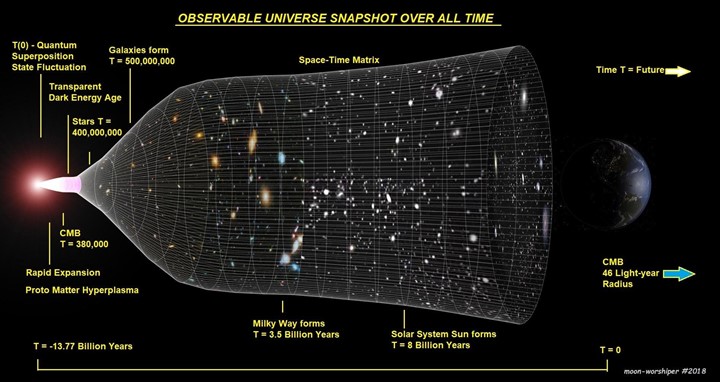

Our Universe is unimaginably large. It has no center and no edge. Dark Energy has been pulling our Universe apart for billions of years. Physicists once thought that our Universe would expand, slow down, and then collapse in on itself to an infinitely small particle called a singularity. We now know that this is not the case. We can see distant stars and galaxies rushing away from us at very near the speed of light. These stars are shifted to the red end of the spectrum, which means that they are moving away from us. We say that these stars are Red Shifted. This is the result of the Doppler Effect. We experience the Doppler Effect all the time with sound waves. We hear an airplane coming towards us and its sound pitch is high but as it moves away from us, we notice that the sound is much lower in frequency. The same thing happens with light.

The SpaceTime that those far-flung objects reside in is expanding at a speed much greater than the speed of light. The individual stars and galaxies are not expanding faster than the speed of light but the SpaceTime itself is expanding faster than C, the letter mathematicians and physicists use to represent the speed of light. It now appears that our Universe will continue to expand forever. Current estimates for the size of our Observable Universe is 93 billion light years in diameter. Many of the objects in our Universe that are farthest away are travelling so fast and have been doing so for so long that their light will never reach us. It is said that these objects are no longer part of the Observable Universe. We will never know anything about them.

What is Outside of Our Universe?

The question is often asked, “What lies outside of our Universe?” We know that there is a fuzzy line that separates our Observable Universe and our Unobservable Universe, but what’s outside of that? Today, most physicists believe that there may be an infinite number of universes, each having a beginning similar to ours. There is no assurance that these other universes, sometimes called Bubble Universes have similar Fundamental Laws or similar chemical elements to ours. However, given that quantum fluctuations caused our Universe to leap into existence it is probable that quantum fluctuations caused these other universes to exist. If that is the case, we can make a reasonable assumption that other universes may have similar fundamental laws. They must have matter and as a result they must have gravity because, as we have stated earlier: SpaceTime tells matter how to move and Matter tells SpaceTime how to curve.

The Curvature of Space


It is difficult enough for our brains that have evolved in a three-dimensional universe with a 4th dimension, that being time to imagine more dimensions of SpaceTime. But trying to get our heads around the idea that Space & Time are one in the same and that SpaceTime is curved is a nearly an impossible concept to grasp. And yet, we have 50 years of observational experience and flawless mathematics to validate the law – matter curves space, there is no way around it. In the picture on the left physicists provide an example of matter curving space. 


Imagine a large rubber sheet with gridlines drawn on it. Now drop our Sun, the Earth, our Moon onto the rubber sheet. Notice how the more massive Sun warps the fabric of SpaceTime more than less massive objects. We can see massive objects, such as our Sun bend the light of a distant star, as our Sun warps the space around it to such an extent that light itself curves. We can observe this phenomenon during a total Solar Eclipse, when the Sun’s light is cut off by the disc of our Moon completely covering our Sun. We observe the light from a distant star, not where it should be if light travelled in a straight line but slightly bent or warped by the Sun’s SpaceTime warping. The light from this distant star has curved around our Sun.  

Conclusion, at least for now

In have introduced a number of physics and astronomical concepts in this paper. The very best scientific minds will tell you, “I really don’t understand exactly how our Universe works.” Every time physicists and astronomers make important discoveries many new questions arise. This is the way science works. Concepts such as SpaceTime, how matter warps SpaceTime, quantum fluctuations, the size of our Universe, the shape of our Universe, and thousands of other complex physics phenomenon will occupy our imagination and our research until the end of Earth time. This is what makes us human, that inexhaustible search for knowledge, how things work, what’s going to happen next. That’s the fun thing about being human, about being alive, there is always something new to figure out.


[i] Written by Dave Stiles, compiled from many books and articles, as well as several other papers including a presentation on Quantum Physics created in 2019 and a longer paper entitled, Astronomy Primer, also written in 2019.

[ii] Physicists and astronomers use the word SpaceTime is used instead of Space & Time. SpaceTime refers to the entanglement of Space & Time in such a way as to be intertwined and inseparable. Einstein postulated that Space and Time are relative depending on the position of the observer, the speed of an object, and the elevation of an object. This is a complex topic and is covered in detail in another paper. Suffice to say, all objects move either through Space or Time. An object at rest moves only through time. As it speeds up more of its motion is through space. As it accelerates towards the speed of light nearly all its motion is through space almost none of its motion is through time. For the accelerating object, approaching the speed of light, time appears to pass normally but the observer of the fast-moving object would say that time appears to stand still for the accelerating object. Many physicists prefer the word personal instead of relative. SpaceTime is personal, depending on your particular state.

Think of it this way: If you are in a car and you move past me at a high rate of speed and I am standing still and I am watching you pass me I notice that the clocks on your wrist, on your phone, and on your car dashboard will tick more slowly than the clocks on my wrist, phone, or in my stationary car. You however, in the speeding car look out your window at me. To you, I seem to be moving in relationship to you. You see my clocks click more slowly than yours. All time is relative or personal depending on your position and viewpoint. This seems impossible, it is a difficult concept to grasp but it is true. Thousands of experiments and measurements over the years have shown it to be true. We are witnessing a mixture of Space & Time, which is why we can use the term SpaceTime instead of just Space or just Time.

Prior to the 20th century Space and Time were considered absolutes, with little relationship to each other. Einstein’s great insight in 1905 was that Space and Time are personal. Einstein reinterpreted Space and Time as relative, not absolutes at all. Causality, a series of connected and dependent events mark the flow of time. Time moves in one direction. Space on the other hand can be moved through forward and backwards. Causality is the fundamental aspect of time. Our experience of the flow of time is a product of that.

[iii] Refer to the book, The 4% Universe, Dark Matter, Dark Energy, and the Race to Discover the Rest of Reality, by Richard Panek. The book demonstrates that, just about everything we learned in school about our Universe is wrong. Only about 4% of our Universe consists of ordinary matter, the stuff that makes up you and me, this paper, the planets & stars, etc. The rest is mostly unknown, a complete mystery.

[iv] The building block elements of life are referred to as CHNOPS, pronounced Cha-nops. This is an abbreviation for Carbon, Hydrogen, Nitrogen, Oxygen, Phosphorus, and Sulfur. All life on our planet is made up of these basic building blocks of organic elements. There are many other trace elements necessary for life but without these six elements life will not occur anywhere in our Universe. Astrobiologists use spectrographic analysis to look at distant stars and their planets to determine if any of these elements are present. Many other conditions need to be met for life to form, the presence of liquid water, the right temperature range, the right size and mass of the planet, its distance from its parent star, the presence of a magnetic field to shield it from harmful radiation from the star, an atmosphere that contains at least some oxygen and nitrogen; all these need to be present for primitive life to begin and survive. Many other conditions need to be met in order for intelligent life to evolve. However, most recent estimates predict that there may be as many as 60 billion planets in the habitable zone that could support life in the Milky Way Galaxy alone. The best guess for the number of potential habitable planets in our entire Universe is 50 sextillion or 1021 power. That’s 1 followed by 21 zeros. Rest assured, there is life on other planets and a sub-set of intelligent life on trillions of planets in our Universe. Given the fact that nothing can exceed the speed of light it is highly unlikely we will ever meet them. Sorry UFO believers.

Why High Corporate Taxes are a Bad Idea


Worst Case Scenario

Every time I hear some uninformed, leftist sheep repeat the party line, “Big corporations need to pay their fair share,” I cringe, right before I throw up. The Biden administration is poised to raise the taxes on Corporations to 28%. The United States already has some of the highest corporate taxes in the world, much higher than the average corporate tax rates in Europe.

What these people don’t seem to realize is that large corporations already pay an enormous portion of their profits in payroll taxes, work benefits, training costs, tuition reimbursement, travel costs, construction & infrastructure costs, billions paid for outdated, outmoded, & needless business regulations; the list goes on and on.[i] Companies that manage to show a profit will now have those profits taxed at 28%. If they do business in Seattle, they pay a business & occupation tax as well and this tax is on the top-line before expenses. Needless to say, large corporations in Seattle get clobbered with taxes stifling business growth and expansion, reducing new job opportunities. The following is a brief explanation of why high corporate taxes are bad for the regular folks and what would happen if United States corporate taxes were dramatically lowered.

Path of least resistance

Corporations will always look for the least expensive way of doing business and increasing shareholder value. That is why so many corporations moved from their US and European locations to China. Companies were willing to sacrifice autonomy, operational freedom, and lack of control in exchange for much lower wages for employees. Who cares if the insanely low hourly wages created a chronically impoverished lower class of workers, barely subsisting, suffering under inhumane working conditions, living in cramped tiny corporate housing, while the corporations emit millions of tons of choking pollutants and greenhouse gasses, exacerbating already unhealthy Chinese air quality? Middle class Americans could barely afford to buy relatively inexpensive $100 Nike trainers, which if they were manufactured in the US would cost far more, erasing this lucrative market. You can imagine what it would cost to buy an iPhone if it were manufactured in the United States instead of China.

Offshore manufacturing

The move to offshore manufacturing had a devastating impact on both the manufacturing job market in the US and on a dramatic decline of the Middle-Class, a group that was once the lifeblood of a uniquely American culture. Loosing manufacturing jobs had a trickle-down effect on nearly every aspect of American livelihood. This cultural shift led to a deepening economic divide between the wealthiest 20% and an increasingly poorer 80% of the US population. A rapidly expanding service-oriented job market, which catered to the upper class presented lots of opportunity, but the accompanying low wages sent millions of low-wage earners to near the poverty line.

Corporate Greed?

One would be inclined to blame this phenomenon on corporate greed but that’s simply not the case. Over the last 20 years we have witnessed a perfect storm ensuring the rapid demise of the middle class in the US.  As emerging third-world nations marched towards economic maturity they put increasing pressure on US corporations to remain competitive. We began to hear a giant sucking sound of Chinese economic growth made possible in China by a broad shift to a tightly controlled market economy (Capitalism). While Mao tse-tung rolled over in his grave China vacuumed up American and European companies eager to lower costs. Higher taxes, a declining US education system engineered by an all-powerful National Education Association (NEA) labor union hastened the shift. The unbelievable expansion of the high-tech industry attracted highly educated software engineers at very high salaries. Parallel to these trends was a comprehensive worsening of economic conditions across Latin America. This led to the largest immigration crisis the US has ever experienced. Corrupt Latin American politicians and powerful drug cartels exacerbated the immigration dilemma.

The Economic crash of 2008

As the US debt and balance of payment deficits increased astronomically, economic conditions in the US were poised for a dramatic downturn and stock market crash. As liberal politicians and bloated bureaucratic Government Sponsored Enterprises (GSE), such as Fanny May and Freddie Mac offered low and no-interest home loans to unqualified home buyers[ii], the bubble was about to burst. Throw in corrupt banking practices (derivatives), a rapid rise of middle eastern cartel oil prices, and the storm was unleashed. And through it all our unenlightened politicians continued to raise corporate taxes, expand the already bloated and wasteful entitlement structure, and manage to get us involved in foreign wars that we had no business being involved in, wars that seemingly lasted forever.

The Solution

Taxing corporations at 28% will not just hurt corporate profits (for the Left, profits are the most immoral thing in the world) but will have a dramatic impact on job growth. Here's what would happen if we dropped corporate taxes to 3%, or 0% or for the first 10 years if off-shore corporations move their manufacturing from China to the US. Corporations from all over the world would suddenly start to do the math.


Here’s what these corporations would be thinking, “Hmm, if I move my corporate headquarters and manufacturing to the United States, build new high-efficiency factories in southeast US where labor rates are lower, I’ll make billions of dollars more in profits and be able to pass my lower costs to consumers, thus dramatically expanding the market for my products. AND, not only that, but I will be able to create millions of new jobs for American workers. I won’t need to do the manufacturing in China, my manufacturing source and markets will be close by. I’ll have the corporate business freedom & control I need to operate most effectively, and dramatically reduce shipping costs.”

Lower Tax Heart Attack

The Federal government will initially have a collective heart attack at the thought of losing all those corporate tax dollars but eventually the government will also do the math. Millions of new jobs bring in billions of dollars of individual tax revenue, far outpacing the loss in corporate taxes. The upward pressure on job availability will almost immediately drop unemployment to less than 2%. These companies will bring their high-paying mid and upper-level management personnel with them, bringing more wealth to the US. Companies will scramble to find suitable candidates to fill the new positions. Companies will be forced to raise hourly rates as well as annual salaries. They will begin expanding their company benefits as they compete for job candidates. The government will be forced to loosen immigration restrictions in order to meet the high demand for both skilled and unskilled laborers. This would certainly trigger an overhaul of our antiquated and unfair immigration laws.

Exploding Economy

New housing-starts will explode; new state-of-the-art factories will sprout up across America. Corporate training programs and associations with colleges engaged in technology-transfer will produce more engineers and scientists. The rise of the Middle Class in the United States will once again become the envy of the world. Market economics will naturally begin to reverse the disparity between have and have-nots as skilled and semi-skilled jobs proliferate.

The Other Shoe…

Any significant cut in taxes, regardless of how beneficial in the long run should be accompanied by commensurate spending cuts. Neither Republicans or Democrats are inclined to reduce spending, sacrifice any of their sacred pet projects, run from pork-barrel political spending, or disappoint their constituents who simply don’t understand that you can’t have low taxes and fiscal responsibility at the same time. Feeding at the government pig-troth is apparently a favorite pastime for 21st century voters. What we need is a Reagan style reborn Grace Commission[iii] that will examine every federal spending program and recommend which programs can be sun-set or cut. This effort could slash many billions of dollars from the budget.

Post Pandemic World

In a post-pandemic world, hybrid work scenarios will become the norm. There will be downward pressure on office rents as high vacancy rates become widespread. Infrastructure costs will actually decrease due to the hybrid work environment; workers will spend 30% to 75% of their time working from home. Gasoline consumption will decrease, greenhouse gasses will decrease, auto expenses will plumet, and auto insurance rates will drop. The hybrid work scenario will help companies take advantage of significantly lower corporate tax rates by enabling them to spend dollars, which were previously taxed, on more hiring, better benefits, higher salaries, and greater spending on their corporate infrastructure.

Higher Education Disruption

The post-pandemic economy has had another unforeseen consequence, which will disrupt our higher education establishment. Elitist Left wing Ivy league universities are bastions of billion-dollar endowments where wealthy alumni wallow in a sea of power, position, and influence. There are hundreds of tier 2 private schools and even some state schools that share the same level of opulence and bloated indulgence. These alumni wield their power and influence enriching the elite colleges infrastructure by constructing lavish and palatial classrooms, dormitories, laboratories, and administration centers. Professors are paid astronomical salaries to publish and occasionally teach in the classroom.

Admission to these schools is accompanied by highly competitive, war-like tactics, which include fraud, corruption, influence buying, and stratospheric monetary gifts. The recent college entrance criminal scandal resulted in fines and jail time for the worst offenders. However, the Wuhan Pandemic has precipitated a major paradigm shift in the delivery of higher education. Online University education, once the purview of popular schools such as Phoenix University and many others has been taken over by nearly every college in the country. Colleges, fearful of COVID outbreaks have been forced to deliver education online. Empty classrooms, dormitories, and college research facilities are stark reminders of the current college education environment. State schools, financed by local taxpayers still pay professors salaries, pay building maintenance costs, and an entirely new expense line-item, building out high-technology online education delivery mechanisms.

Financially strapped students, paying absurdly high tuitions costs are joining forces with other students and legal teams across the country in class-action lawsuits claiming, “Hey, we didn’t get what we paid for, we were supposed to get in-person teaching and now it’s sub-standard online learning…we want to be compensated, reimbursed, made whole.” Something must give. There is a massive shift underway, moving away from University education. This will eventually cause many schools to close and others to trim their budgets. The tuition loan repayment crisis[iv] will be exacerbated as students, who took out over 1 trillion dollars of student loans struggle to pay crushing debt. All these trends put pressure on traditional University education.[v]

Chinese Hegemony

China of course will be left holding the bag. Their economy will falter as tax revenues quickly abate. While I don’t wish misery on anyone, if the misery-index gets high enough in China perhaps the people, once accustomed to some degree of survivable subsistence will revolt and throw off the yoke of Communist oppression. One can only hope; freedom is a beautiful thing. Regardless, the era of Chinese hegemony will unceremoniously end.

Conclusion

This is the problem defined and solution presented. High corporate taxes have a negative impact on job growth and economic development in general. This situation puts the American economy in peril. The best way to grow an economy and sustain that growth is to create opportunities for all Americans. In order to do this, you must restore a vibrant and healthy middle class. This is possible by luring large global manufacturing and engineering companies back to the US with low or no corporate tax rates. The economic impact of low corporate taxes has a trickle-down effect, which ultimately grows the overall tax revenues. Couple this with sensible reduction in government spending, education reform, business regulation reform, immigration reform, continued support of a modern and disruptive AI based technology revolution, an energy production revolution[vi] and economic growth for all will be assured, it is a sustainable economic solution that will benefit all market segments and economic strata.


[i] Large corporations such as Amazon are widely criticized by the left for paying little corporate taxes, in reality, Amazon pays billions in other taxes, investment in infrastructure, in their employees, investing in their community, and by creating thousands of new jobs. Those new employees pay individual income taxes that far outweigh the corporate taxes.

[ii] Freddy Mac Fannie Mae wrote millions of bad home loans resulting in millions of foreclosures; Commercial banks follow suit.

Oil prices climb to record levels halting economic growth. Unscrupulous bank executives using derivatives along with other shady financial instruments, for their own benefit in an attempt to mask the crisis, triggered The Perfect Storm. Freddy Mac and Fannie Mae paid millions of dollars to its sponsors in bonuses, mostly to US Democratic Congressmen. It was the largest political/financial scandal never reported. 

[iii] The Grace Commission was a President Ronald Reagan Executive Order, which was also sponsored by the W. R. Grace company. It was an independent team of inspectors looking into wasteful spending at all levels of government. The report, which was released in January of 1984 showed that if its recommendations were followed, $424 billion could be saved in three years, rising to $1.9 trillion by the year 2000. Unfortunately, but certainly expected, Congress ignored most of the recommendations, choosing to keep the status quo of Pork Barrel Political Spending and amassing even greater budget deficits.

[iv] One interesting solution to the Student Loan Repayment Crisis would be to require colleges to cosign for student loans. Presently, colleges don’t care if you come to class, pass your courses, graduate, or get a job, which will allow you to pay off your student loans. All they care about is getting the government funded tuition dollars into their treasury. However, if they had to cosign for those loans, they would immediately have a vested economic interest in encouraging their students to attended class, pass their courses, get their degrees, and ultimately find good paying jobs. Taking some fiscal responsibility for their students’ success would lead them to emphasize the degree programs that were most likely to generate viable incomes upon graduation. Students majoring in Photography, Radio & Television, Culinary Arts, Fashion Merchandising, Art History, and Women’s Studies, are not likely going to be offered many college sponsored loans. If you want to major in these programs be prepared to pay for them on your own.

[v] The COVID-19 has resulted in schools shut all across the world. Globally, over 1.2 billion children are out of the classroom.

As a result, education has changed dramatically, with the distinctive rise of e-learning, whereby teaching is undertaken remotely and on digital platforms. Some Research suggests that online learning has been shown to increase retention of information, and take less time, meaning the changes coronavirus have caused might be here to stay.

While countries are at different points in their COVID-19 infection rates, worldwide there are currently more than 1.2 billion children in 186 countries affected by school closures due to the pandemic. In Denmark, children up to the age of 11 are returning to nurseries and schools after initially closing on 12 March, but in South Korea students are responding to roll calls from their teachers online. With this sudden shift away from the classroom in many parts of the globe, some are wondering whether the adoption of online learning will continue to persist post-pandemic, and how such a shift would impact the worldwide education market. Even before COVID-19, there was already high growth and adoption in education technology, with global Edtech investments reaching US$18.66 billion in 2019 and the overall market for online education projected to reach $350 Billion by 2025. Whether it is language apps, virtual tutoring, video conferencing tools, or online learning software, there has been a significant surge in usage since COVID-19. How is the education sector responding to COVID-19?

In response to significant demand, many online learning platforms are offering free access to their services, including platforms like BYJU’S, a Bangalore-based educational technology and online tutoring firm founded in 2011, which is now the world’s most highly valued Edtech company. Since announcing free live classes on its Think and Learn app, BYJU’s has seen a 200% increase in the number of new students using its product, according to Mrinal Mohit, the company's Chief Operating Officer.

Tencent classroom, meanwhile, has been used extensively since mid-February after the Chinese government instructed a quarter of a billion full-time students to resume their studies through online platforms. This resulted in the largest “online movement” in the history of education with approximately 730,000, or 81% of K-12 students, attending classes via the Tencent K-12 Online School in Wuhan.

Other companies are bolstering capabilities to provide a one-stop shop for teachers and students. For example, Lark, a Singapore-based collaboration suite initially developed by ByteDance as an internal tool to meet its own exponential growth, began offering teachers and students unlimited video conferencing time, auto-translation capabilities, real-time co-editing of project work, and smart calendar scheduling, amongst other features. To do so quickly and in a time of crisis, Lark ramped up its global server infrastructure and engineering capabilities to ensure reliable connectivity.

Alibaba’s distance learning solution, DingTalk, had to prepare for a similar influx: “To support large-scale remote work, the platform tapped Alibaba Cloud to deploy more than 100,000 new cloud servers in just two hours last month – setting a new record for rapid capacity expansion,” according to DingTalk CEO, Chen Hang.

Some school districts are forming unique partnerships, like the one between The Los Angeles Unified School District and PBS SoCal/KCET to offer local educational broadcasts, with separate channels focused on different ages, and a range of digital options. Media organizations such as the BBC are also powering virtual learning; Bitesize Daily, launched on 20 April, is offering 14 weeks of curriculum-based learning for kids across the UK with celebrities like Manchester City footballer Sergio Aguero teaching some of the content. What does this mean for the future of learning?

While some believe that the unplanned and rapid move to online learning – with no training, insufficient bandwidth, and little preparation – will result in a poor user experience that is unconducive to sustained growth, others believe that a new hybrid model of education will emerge, with significant benefits. “I believe that the integration of information technology in education will be further accelerated and that online education will eventually become an integral component of school education,“ says Wang Tao, Vice President of Tencent Cloud and Vice President of Tencent Education.

There have already been successful transitions amongst many universities. For example, Zhejiang University managed to get more than 5,000 courses online just two weeks into the transition using “DingTalk ZJU”. The Imperial College London started offering a course on the science of coronavirus, which is now the most enrolled class launched in 2020 on Coursera.

Many are already touting the benefits: Dr Amjad, a Professor at The University of Jordan who has been using Lark to teach his students says, “It has changed the way of teaching. It enables me to reach out to my students more efficiently and effectively through chat groups, video meetings, voting and also document sharing, especially during this pandemic. My students also find it is easier to communicate on Lark. I will stick to Lark even after coronavirus, I believe traditional offline learning and e-learning can go hand by hand." World Economic Forum, Cathy Li, Farah Lalani, April 2020.

[vi] The federal government in association with key energy businesses must fast track 4th Generation Nuclear Power. An aggressive plan could achieve the goal of generating 80% of our electricity in 20 years. 4GinNP is the greenest, cleanest, safest, and most efficient method of creating electricity. This plan will dramatically reduce out carbon footprint, get us off the petroleum spigot, create millions of new high-paying jobs, enable electric vehicles to operate more cheaply by flooding the grid with abundant low cost electricity.

Tuesday, May 31, 2016

Socialism, The Problem

Socialism, the problem
There are many issues with Marxist-Socialism and I will not go into all of them. The great quote by Margaret Thatcher, “The problem with Socialism is that at some point we run out of other people’s money” while poignant is symptomatic of deeper issues.

The real problem is much more fundamental. The human species operates primarily based on our DNA’s ability to determine what makes people look like, think, act, and function the way we do. If you go back to the very beginnings of civilization you will notice that, at some point humans started to live in larger groups, primarily out of convenience and efficiency.
Coinciding with this, humans gave up hunting and gathering for the efficiency of farming and manufacturing. During those early times, one person began to make weapons or grow barley, which they made mildly alcoholic barley water, or whatever. Others saw these more functional items and said, “I see you have a cool knife, I’d like one of those knives for myself.” They turned to the guy who made the better knife and said, “I’ll give you something of value in exchange for one of those knives.” Therefore, the market place was born. That is the beginning of Capitalism. It was also the beginning of civilization.

The marketplace is deeply embedded in our psyche, in our culture, and in our DNA. It forms the basis of human interaction. No organization needs to encourage people to exchange things of value in order to satisfy their needs, wants, and desires. It happens naturally.
Socialism refuses to acknowledge or recognize this basic aspect of human nature. Socialists cannot bring themselves to believe that the marketplace responding to the needs, wants, and desires of human beings is that unique mechanism that has shaped all human interaction.

The marketplace created civilization. It created the orderly and civil interaction between people seeking to satisfy deep needs and desires through the exchange of products and services for items or tokens of similar value.
Out of the marketplace came the very best of human ingenuity. Every innovation in every area of life emerged as a result of the marketplace fostering creativity, ingenuity, and innovation. If you prevent the marketplace from functioning, innovation, creativity, and ingenuity will cease. We only need to look at Socialist countries where the State owns a key industry and see how inefficient it is.

By not grasping the idea that the market is a basic component of human nature Socialism starts out on the wrong foot. By completely misunderstanding human nature it is impossible for Socialism to ever build a successful pattern for human activity. Socialism postulates that human beings are not essentially market driven but are instead motivated by a spirit of cooperation and a desire to subjugate individual needs and desires to the group. Socialism says that human beings have a natural propensity to satisfy needs and desires of others based on the inherent goodness and altruism of humans towards one another. This is a false premise.

Socialism contends that humans are motivated by a desire to share equally with one another and are inclined to submit to a system that regulates that egalitarian sharing. Socialists further believe that social factors and the inherent evils of the marketplace have conspired to discourage us from naturally migrating to that egalitarian, altruistic, and collective way of thinking. They believe that the marketplace is responsible for all of civilizations evils, everything from wars, religions, even epidemics can ultimately be traced back to human infatuation with the marketplace.

Socialists often talk about creating a level playing field. What they mean by this is finding the lowest common denominator of human needs and wants and requiring everyone to play (function) at that level. Trying to create greater wealth or accumulate more than others is counterproductive. It will only lead to strife and envy.
When one person accumulates greater wealth those who don’t have as much (the downtrodden), Socialist contend that the downtrodden should be given some of what the wealthy person has accumulated. This is called wealth re-distribution. Socialists believe that this wealth re-distribution is good for the society.

The reality is that it is giving into a base human trait; envy. Envy leads to jealousy and eventually to violence. If the wealthy won’t willingly part with their wealth the downtrodden masses must take it forcefully. Ill-gotten gain is hollow. Taking something from someone else, someone who has worked hard to get it is a form of theft. The idea of taking something you didn’t work for from someone who did violates the very foundation of human nature and jeopardizes the ultimate success of civilization. Collective sanctioned thievery is the hallmark of Socialism.

In reality the marketplace naturally creates an opportunity for anyone to accumulate wealth for themselves. The purpose of wealth is not to beat the downtrodden but to satisfy our needs, wants, and desires. Capitalism is designed to create wealth for the greatest number of people. This is real common good, the ability to satisfy needs, wants, and desires for the greatest number of people.

Socialists reject this idea. They see wealth opportunity as an evil. It must be expunged from the minds of human beings. Socialists contend that people must be “encouraged” to abandon the marketplace through social engineering. Socialist institutional systems must arise that will generate this new and better cultural norm. Schools, the family, the government all must cooperate to instill this new way of thinking into the hearts and minds of citizens. This economic philosophy is called State-ism or centralized economic planning.
The State represents the highest order. The State is managed for the good of us all by experts. These experts are economically enlightened and are highly intelligent. This group of specialized ruling elite is called an oligarchy.

The concepts of individual liberty and personal freedom are viewed as impediments to Statist approach. Socialists contend that individual liberties and personal freedoms must always be subjugated to the more enlightened centralized system and Socialist policies of the oligarchy.

When people object to the centralized planning of the oligarchy and pursue the marketplace they must be restrained and reconditioned until they see the light. Eventually everyone will relinquish their desire for individual freedom and personal liberty and all the people will live happily together, sharing, cooperating, and willingly submitting to the State. 
Do you see the difference? Humans are naturally market focused but must be coerced to be Socialists. Socialism never happens naturally. There is no genetic pre-disposition to desire Socialism.

Whenever you try to force someone to do that which they aren’t naturally inclined to do you run into problems. That is why Marxist-Socialism and Communism have never succeeded. It is why the various Utopian communities throughout the world always fail. The idea of giving up personal freedom and individual liberty for the so-called common good can never succeed. That’s because there is no such thing as the common good. The common good always degenerates into the common bad.

The founding fathers referred to The Common Good in their writings as the purpose of Government. Most of the founding fathers understood that liberty and government don’t always go hand in hand. However, the Government must protect the people from attacks both domestic and foreign. The government exists to provide a stable platform for the nation to function.

They referred to this stability as the common good. The founding fathers envisioned the least government possible to keep the nation stable and operational. That is why they wrote the Tenth amendment, powers not specifically stated in the Constitution go to the states. They intended for the greatest power and authority to be held and exercised by the individual citizens. The greatest governmental power was to be held by the smallest and most localized governmental institution, that being town councils and local, democratically elected officials.

Beyond that, the next level up of governmental entity was to be held by the individual states. Some try to extrapolate Stat-ism from a very broad definition of the common good but that was never the intention of the founding fathers. Remember, they had just emerged from the evils of an oppressive government so they wanted to create something as far away from that as possible.

When a political or economic system can only be widely adopted at the point of a gun you know the system is inherently wrong. That is the case with Marxit-Socialism. It sounds good, it sounds like it should work and make the world better but when you try to institute it human nature gets in the way.

Humans are so deeply motivated by the desire to be free and participate in the market that they naturally resist Socialism’s best (or worst) efforts. Humans always go back to what they do best, freely exchanging goods and services for items of similar value.
Economists refer to that idea as Capitalism, the free and equitable exchange of goods and services for capital. As people began to accumulate capital their lives changed dramatically. Capitalism is the single greatest social welfare program in the history of the world. More people have been delivered from poverty through Capitalism and a free-market than any other social invention. All the well - intentioned government programs designed to eradicate poverty and create upward mobility pale in comparison to the positive impact of capitalism.  


[i] 

Thursday, October 29, 2015

As I Recall


As I recall

I’ve been hunting deer for about 10 years and only recently have I had some success. I wasn’t doing everything right but still having fun and learning in the process. Five years ago I got close; stared down some does in a field until they finally moved on. The year before that I spooked a big Whitetail in the NE corner of Washington State. The deer moved so fast I couldn’t even get my gun to my shoulder and it was gone.

Two years I did some Turkey hunting north of Spokane at a buddy’s place. We got a turkey and we saw some Whitetails. We even saw a moose; I knew they existed in Washington State but never actually saw one. A couple of months before the opening of the season by buddy Reggie called me and told me that a friend of his had 250 acres of private land that we could have exclusive access to if we wanted to go. In addition, the land was adjacent 1,000 acres of public land so the opportunities for deer would be good. His friend told us, “The place is crawling with deer.” This sounded like a good deal to me so we began to make plans to hunt the property.

Five years ago I took up hand-loading. Since I own a Weatherby .270 I started out with simple and inexpensive reloading equipment from Lee including their .277 dies. Reloading was fun, a great hobby, and a real money saver. Plus, I could custom load my rounds and learn a ton about ballistics. I took the loads I was going to use for deer season to the range and sighted in my gun. When I consistently got tight groups I packed up the rifle and pronounced myself ready.


We arrived at my Reggie’s home on Thursday afternoon, a day and a half before the opening of deer season. On Friday morning we drove down to the property and met up with his friend; he was actually my buddy’s insurance salesman. He had a nice place on some perfect acreage for deer hunting. Everything you imagine about good deer hunting property; this was it. In addition, there were a few vantage points from which to glass around.

After spending all morning touring the property; “You could hunt here or you could hunt over there.” I point blank asked him, “If it were you, where would you go on this land?” He responded, “I’d go right to that corner over there.” So that’s exactly what we did. After a couple of beers at his house we jumped back in the truck and headed for Reggie’s home and some good eating.

The following morning on Saturday we got up at 4:00 AM. My son Kevin and I grabbed a cup of coffee, a banana muffin, and headed for the property. It all looked a little different in the darkness but we managed to find the access road. At about 5:30 we pulled the truck off the side of the road and walked in the last ¼ mile. Our headlamps barely illuminated the ground below us even though it was a clear sky. The stars were still shining brightly.

Getting over the barbed wire fence in the dark was challenging but excitement was in the air with the opening day of deer season in Eastern Washington. Our mood was upbeat as we found the precise location we had visited the previous day. All we had to do was find a good sitting place and wait for the action to happen.

Kevin blinked his flashlight letting me know just how far he was from my spot. I responded with a blink or two from my headlamp. As we settled in for what I assumed would be a long morning and afternoon the sky began to lighten just a bit and I realized I was sticking out visibly. I adjusted my position and made sure I was behind some large branches, which had fallen to the ground. Kevin was propped up against a tree; I could barely see his blaze orange through the grasses.

At about 7:00 AM, as my back began to get a little sore from leaning forward the old negative thoughts ran through my brain. “It’s going to be just like every year; we sit all day and don’t see a thing. Why do I continue to do this every year?”

No sooner had I the thought crossed my mind and I noticed some movement out of the corner of my left eye. As I strained to look in the early light I could see it was a deer. With great stealth and silence I raised the binoculars up to my eyes. My first thought was that this had to be a doe but as the image crystalized in the glass I could see it was a solitary buck and a big one at that.

Twenty yards south of me my son was leaning up against a large fir. His eyes were beginning to close. He and my buddy had jammed on guitar and drums until late so 4:00 AM came all too soon. I knew he was tired; his conversation was brief as we drove to the hunting spot and walked the quarter mile to the field. His pseudo-nap was about to be abruptly punctuated.

Slowly I dropped my binoculars to my chest. My gun was resting along my right side; the barrel propped up on a branch. I had positioned my Weatherby Vanguard .270 made so I could grab it quickly and get it to a firing position with little effort or noise. As my hands gripped the stock I prayed that the noise I was making would be heard by me and me alone. Almost by magic the large Whitetail buck appeared in the crosshairs of my scope. He was completely oblivious to my presence, his head down scraping some fresh grass off the frosted field.

The deer was angled away from me his head pointing towards the road we had previously walked down, at about 2 o’clock and his tail pointing about 7 o’clock towards my left side. In an instant I aimed just behind his ribcage knowing that the shot would do maximum damage traveling at an angle through his vitals.

With a sharp squeeze I pulled the trigger. The loudness of the shot startled me but I could see immediately that the deer was hit. The big Whitetail buck hit the ground instantly, his legs twitching for a second or two at the most. It was a clean kill; nearly painless I imagine for the animal who never knew what hit him and who lost consciousness in a matter of seconds.

I looked over at where Kevin was sitting. The sound of the rifle startled him out of his twilight zone. He jerked forward and looked over at me with his mouth agape. He was confused as to what had just happened. My fist was pumping in the air and the grin on my face alerted him that the shot was related to our day’s agenda. With my left hand I pointed at the downed deer. He could see the deer on the ground and suddenly his brain computed it to reality.

“I can’t believe it; you got a deer. I can’t believe it, you shot a deer.” Like a broken record he repeated the phrase four or five times. He bounded over to where I was sitting and we high-fived. He was far more ecstatic than I was; he was thrilled for me.

It took me a few moments to get my head around the whole concept. My first deer after 6 years of hunting and he was a big one. All the hard work, buying the gear, sighting in the gun, the long rides over to Eastern WA, the reading, the studying, listening to the experts, and the disappointment had finally paid off.


We walked the 80 yards across the plowed field to the narrow strip of grass by the road we had walked down not two hours earlier. At 7:05 my season was over and my tag was filled. I poked my gun barrel into the deer’s eye but there was no reaction. We could see where the bullet had entered but couldn’t see the exit at this point. Kevin uttered half joking, “Now what do we do?”

While he walked down the ¼ mile to get the truck I suddenly realized that I needed to field dress this deer. It was cold, around 28 degrees. There was frost on the field that we only just noticed. Then I recalled that I hadn’t discharged my gun. Kevin quickly cycled the bolt and popped the trap door to remove the other two cartridges. In the excitement of success I had completely forgotten the rules; cycle another cartridge in case you need a second shot then remove the remaining ammo from the gun. I saved that spent cartridge. I’ll reload it and perhaps it will bring me luck next year.

Now my heart was pounding as reality set in. I wasted no time getting my knife out and began cutting through the underside. I had built a chest spreader out of ply wood; it looked like a giant dog bone. Using a common drywall saw I cut through the sternum and opened it up. In a matter of moments we had disemboweled the deer letting the crisp cold morning air chill the open cavity. It was almost as though I knew what I was doing.


We were so excited we called everybody we knew, those that would care anyway and delivered the great news. Kevin kept repeating, “I can’t believe you shot a deer, this is amazing.” It was a wonderful experience, one I’ll never forget. I felt especially privileged to be able to get a deer of this size. I also felt privileged to be able to hunt with my son knowing that he took a few of his vacation days to spend with me. I am very thankful.

I had never butchered a deer before but my 15 years in the restaurant business taught me a lot about cuts of meat. I spent the next 6 hours learning how. Fortunately my buddy Reggie’s friend Cliff showed up when we got back to the garage and hung the deer. Cliff had taken well over 100 deer from the time he was a boy living in Montana. Cliff was not only knowledgeable but he was eager to guide me along and dive right in. He pulled out his razor sharp pocket knife and made some strategic cuts. In no time we had removed the rib-eye on either side of the backbone. The fraternity of hunters is alive and strong.


I spent the better part of the day cutting every scrap of meat from that carcass. When I had finished there wasn’t much left and the whole thing fit into a single green garbage bag. Kevin and I doubled bagged all the primal cuts and immediately popped them in the freezer. We amassed a large bucket of meat scraps that I knew would make some darn good deer sausage.

Part of me wanted to leave for home the very next morning but Kevin, Reggie, and now Cliff were having such a great time jamming that it seemed right to take Sunday off and enjoy it as a real vacation day; a suitable rest from our busy world and the previous day’s hunting activities.

Monday morning came around too soon. I hated to leave the beautiful log home and the pristine environment that had been our respite for the past few days. I hated to part with the memories of the hunt and the collaborative activities that had made this Saturday in October so sweet.

There may be other deer in my future but none as memorable, as joyous, or exciting as the first. The ride back to Seattle was unsettling because it meant a return to civilization and a hard reminder that the hunting trip was over. Now it was time for the dreaming and planning of next year’s hunt to begin all over again.